
DeSoto, TX • Dallas County • Blog
How to Match Drywall Texture After Water Damage in DeSoto, TX
By DeSoto Drywall Pros • November 6, 2026
To match drywall texture after water damage, first identify the texture, knockdown, orange peel, or smooth, then apply the same material with the same tool and technique, feather the edges wide, let it dry, prime, and paint the whole wall or ceiling plane. A patch that is only primed and spot-painted will almost always show. Call (469) 933-0245 and we will match it for you.
A water damage repair is only finished when you cannot see it. New drywall, taped and mudded perfectly, still looks wrong if the texture does not match the rest of the wall. In side light, a smooth patch on a textured wall stands out like a blank rectangle. Texture matching is the step that makes a repair disappear, and it is the step most often skipped.
24/7 • DeSoto, TX 75115 & 75123 • About 25 km around DeSoto
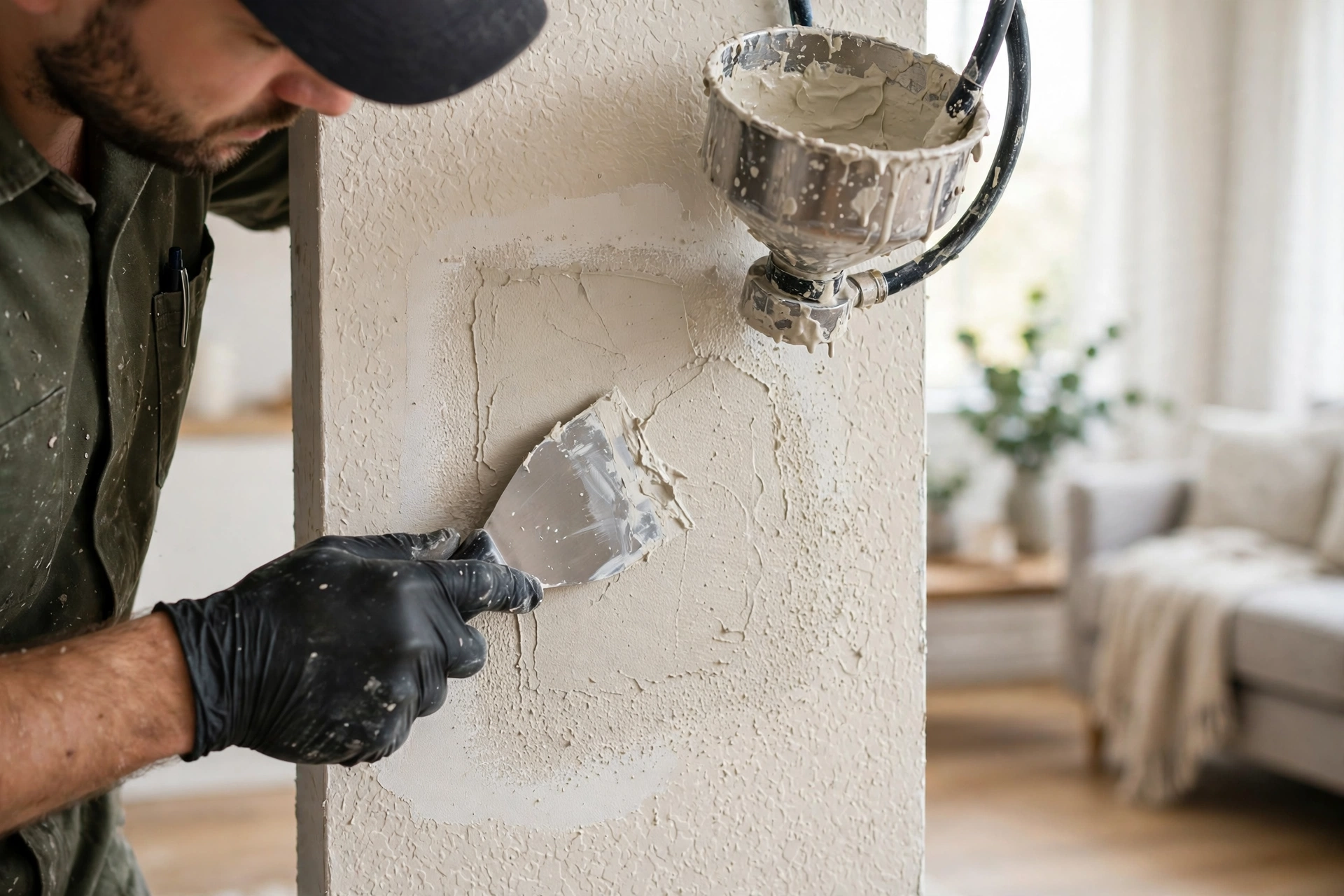
Step by Step
How to Match Drywall Texture After Water Damage: Step by Step
Matching texture is a process, not a product. The same can of texture spray gives a different result in different hands, because the result depends on the mix, the tool, the distance, and the knockdown pass. Here is the order we follow.
1. Let the patch dry completely. Texture goes on only after the joint compound is fully dry and sanded smooth. Texture over damp mud traps moisture, and the patch will crack or peel. This is also why the wall has to be dry inside before the board goes up. See our guide on how long drywall takes to dry after water damage if the wall is still wet.
2. Identify the texture. Look at the wall in side light, from a low angle, and feel it with your palm. Knockdown has flattened, irregular peaks. Orange peel has small, even bumps like the skin of an orange. Smooth has no texture at all, just a flat finish. There are other textures too, such as slap brush and popcorn on ceilings, but knockdown and orange peel cover most DeSoto homes.
3. Test on a scrap board first. We always test the mix and the spray pattern on a piece of scrap drywall before touching your wall. The test shows whether the splatter size and the flattening match. Adjusting on the wall means sanding off a bad pass and starting again.
4. Mask and protect the room. Texture spray drifts. We mask the floor, the trim, and nearby walls with plastic and drop cloths, and we seal the room off from the rest of the house.
5. Spray the patch, then feather outward. The texture goes on the patch and is feathered out past the repair, so there is no hard line where the new texture stops. A hard edge is the first thing the eye catches.
6. Knock it down at the right moment. For knockdown, the sprayed splatter is flattened with a wide knife after it sets for a few minutes, but before it dries. Too soon and it smears. Too late and it will not flatten. Timing is the skill.
7. Let it dry, prime, and paint. Texture has to dry fully before primer. Then we prime the patch, because bare joint compound drinks paint differently than the old wall, and a patch painted without primer will flash, showing a dull rectangle. Then we paint the whole plane, not just the patch.
Know Your Texture
Knockdown, Orange Peel, or Smooth? How to Tell Which Texture You Have
Most DeSoto homes built from the 1970s onward have one of three wall textures. Here is how to tell them apart.
Knockdown. The most common texture in Texas homes. It looks like flattened splatters, irregular in size, with smooth low spots between them. It is made by spraying thinned joint compound onto the wall, waiting a few minutes, then lightly flattening the peaks with a wide drywall knife. Knockdown hides small flaws well, which is one reason builders like it.
Orange peel. Fine, even bumps across the whole surface, like the skin of an orange. It is sprayed on with a hopper gun and left as it lands, with no flattening pass. Orange peel is thinner than knockdown and easier to touch up in small spots, but a bad touch-up still shows as a smooth circle.
Smooth. No texture at all. The wall is taped, mudded, sanded, and skim-coated until it is flat. Smooth walls show every flaw, so the finishing has to be near perfect. A smooth patch on a textured wall, or a textured patch on a smooth wall, is obvious from across the room.
Ceiling textures. Ceilings in older DeSoto homes may have popcorn or stipple texture. Popcorn is the hardest to match, because it is sprayed thick and every ceiling has aged differently. If your ceiling texture dates from before the 1980s, have it tested before anyone sands or scrapes it, because some old textures contain asbestos. We will tell you if testing is needed before we start.
If you are not sure which texture you have, send us a photo or call (469) 933-0245. A photo in side light is usually enough for us to tell.
The Invisible Repair
Why a Visible Patch Is a Bad Patch
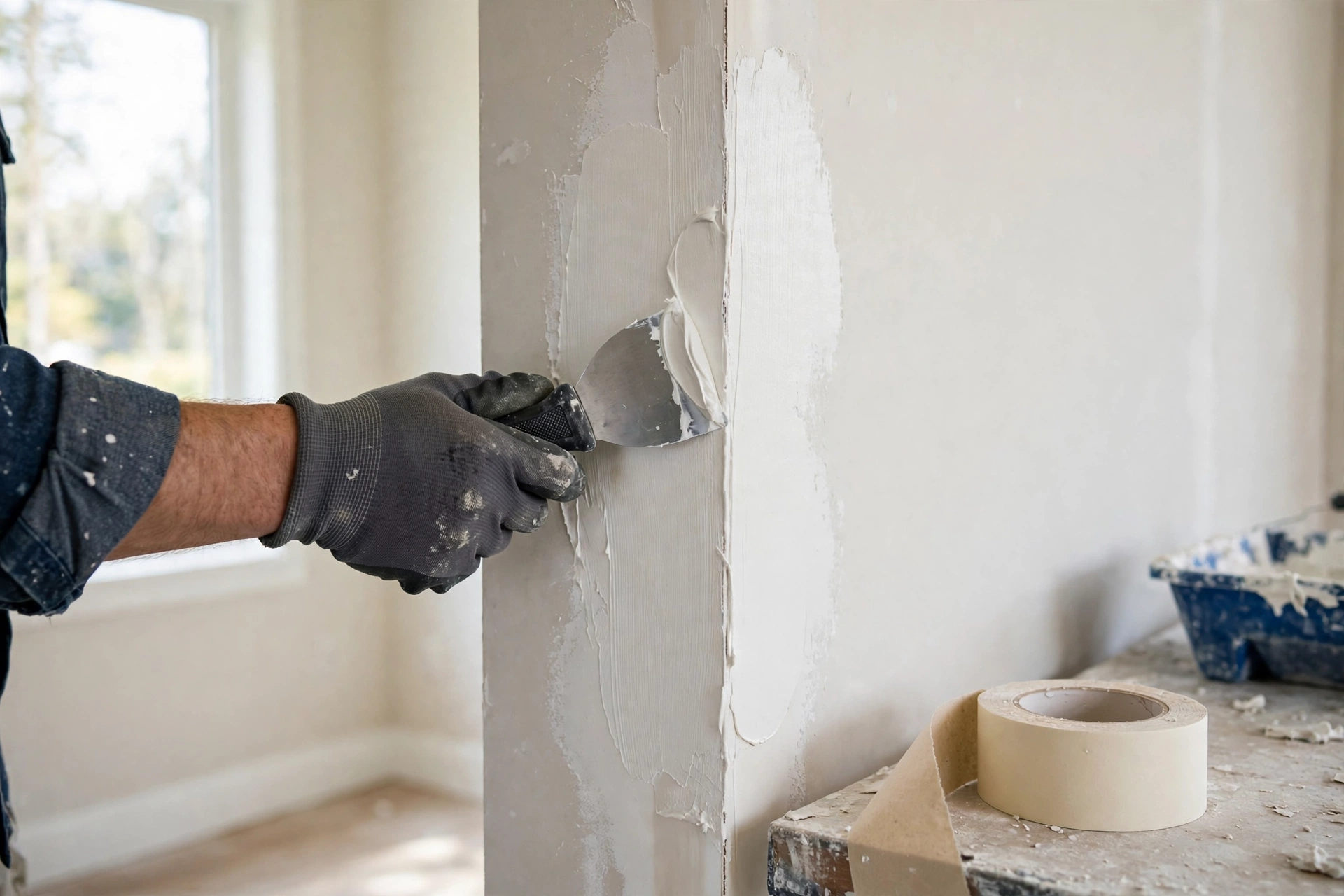
A patch is not finished when the wall is flat. It is finished when you cannot find it. A visible patch fails in three ways, and each one has a different cause.
A hard edge. If the texture stops in a sharp line, or the joint compound is sanded to a hard edge, the eye follows the line. The fix is feathering: every coat of mud and every pass of texture extends further out than the one before, so the repair fades into the old wall instead of ending at it.
A different sheen. Bare joint compound absorbs paint differently than old painted drywall. A patch painted without primer looks dull and flat next to the rest of the wall, even in the same paint. Primer seals the patch so the paint sits the same way everywhere. This is called flashing, and primer is the cure.
A spot-painted square. Old paint fades and ages. New paint, even from the same can, is a slightly different color and sheen. Painting only the patch leaves a visible square. Painting the whole wall, or at least to a natural break such as a corner or a doorway, makes the repair disappear.
Light is the final judge. We check every patch in side light, with a work light held low against the wall, because that is the light that shows flaws. A patch that looks fine in flat overhead light can show every edge in evening light from a lamp. If it shows in side light, it is not done.
Ceilings
How to Match Drywall Texture After Water Damage on Ceilings
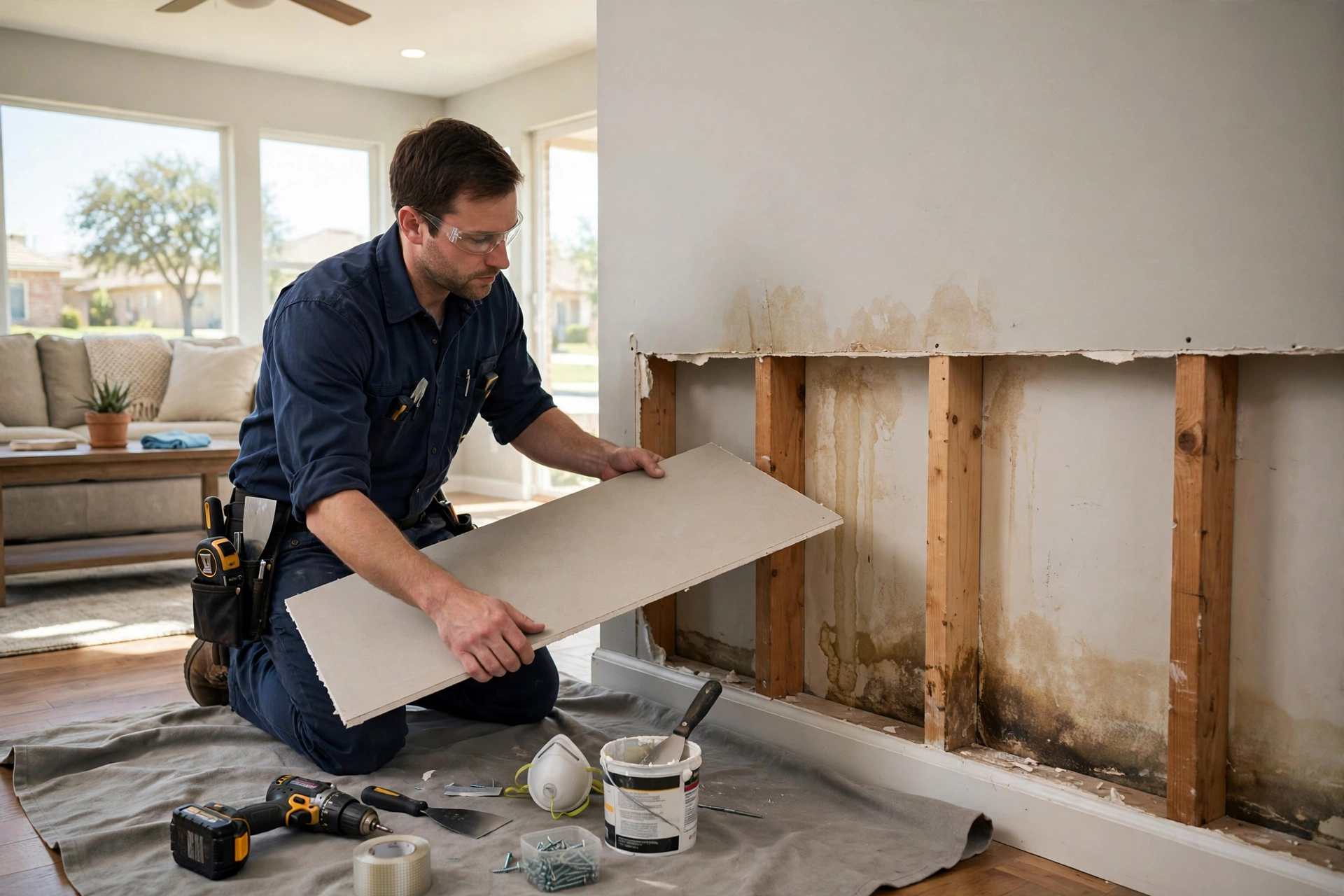
Ceilings are harder than walls. Gravity works against the texture, the work is overhead, and the light comes from below, which shows every flaw. A ceiling patch that is slightly proud of the surface casts a shadow.
The process is the same, but the technique changes. The mix is a little thicker so it does not drip, the spray is done in short passes, and the knockdown pass is lighter, because pressing hard on a ceiling patch can push the new board out of line. We work in sections and keep the texture wet edge moving, so one pass does not dry before the next lands.
Popcorn ceilings deserve a warning. Matching old popcorn is difficult, because the material has aged, yellowed, and flattened over the years, and a fresh patch will look brighter and sharper. In many cases the best result comes from re-texturing the whole ceiling plane, or at least to a natural break. And as noted above, popcorn texture from before the 1980s should be tested before it is disturbed.
If your ceiling was damaged by a roof leak or a leak from a bathroom above, the ceiling board usually needs replacing, not just texture. See our ceiling water damage repair page, and our guide Can You Paint Over Water Damaged Drywall in DeSoto, TX? for when paint alone is enough and when it is not.
Mistakes
The Mistakes That Make a Repair Stand Out
- Texturing over damp mud. The texture cracks or peels. Wait until the compound is fully dry and sanded.
- Skipping the test board. The first spray on your wall is not the time to find out the mix is wrong. Test on scrap first.
- Stopping the texture at the patch edge. Feather out past the repair, or the edge will show.
- Knocking down too early or too late. Too early smears the splatter. Too late and it will not flatten. A few minutes is the window.
- Skipping primer. The patch will flash, showing as a dull rectangle no matter how many coats of paint go on.
- Spot-painting. Paint the whole plane, or at least to a corner or doorway.
- Using the wrong sheen. Flat paint hides flaws. Eggshell and satin show them. Match the sheen of the existing wall, not just the color.
- Texturing a wall that is still wet inside. If the wall cavity is still damp from the leak, the repair will fail. Dry first, then finish. See how long drywall takes to dry after water damage.
Cost
What Does Texture Matching Cost?
Texture matching is usually part of the drywall repair, not a separate job. These are typical U.S. ranges, not a DeSoto quote.
| Job | Typical U.S. range |
|---|---|
| Small patch, texture matched and primed | $150 – $400 |
| Wall section replaced, texture matched | $350 – $1,500 |
| Ceiling section, texture matched | $500 – $1,500 |
| Full ceiling re-textured to a natural break | $1,000 – $3,000+ |
What moves the price? Ceilings cost more than walls, popcorn costs more than knockdown, and painting the whole plane costs more than a patch but looks far better. Call (469) 933-0245 for an exact quote. Our drywall texture matching service page has the full picture.
DeSoto, TX
Texture Matching After Water Damage in DeSoto, TX
DeSoto homes are mostly one-story and split-level brick homes built in the 1970s and 1980s, and most of them have knockdown texture on the walls and either knockdown or popcorn on the ceilings. That matters, because a repair has to match the texture your home already has, not the texture that is easiest to spray.
We work across DeSoto, in ZIP codes 75115 and 75123, and in neighborhoods including The Meadows, Thorntree, Eagle Crest, Brandonwood, Frost Farms, Amber Terrace, Hidden Lakes Estates, and Summit Parks. We also serve Duncanville, Cedar Hill, Lancaster, Glenn Heights, Ovilla, Red Oak, and Grand Prairie. For the local picture, see our water damaged drywall repair in DeSoto, TX page.
FAQ
Matching Drywall Texture — Questions We Hear in DeSoto
Can you match knockdown texture exactly?
We can match it very closely, and in most rooms you will not find the patch. An exact match depends on the age and wear of the existing texture. We test the mix on a scrap board first, and we feather the patch wide so any tiny difference fades into the wall.
Why does my patch show even after painting?
Usually one of three reasons: a hard edge where the mud or texture stopped, no primer so the patch flashes dull, or spot-painting, where the new paint is a slightly different color and sheen than the old paint. All three are fixed by feathering, priming, and painting the whole plane.
Do you have to paint the whole wall?
Usually yes, or at least to a natural break such as a corner, a doorway, or a ceiling line. Old paint fades, so new paint on just the patch will show as a square. Painting the full plane is what makes the repair disappear.
How long does texture matching take?
The texture itself takes an hour or two. The waiting takes longer: the joint compound has to dry fully before texture goes on, and the texture has to dry fully before primer and paint. A typical wall repair is texture-ready a day after the board goes up, and paint-ready a day after that.
Can texture be matched on a ceiling?
Yes, and it is harder than a wall, because the work is overhead and the light shows every flaw. Knockdown and orange peel can both be matched on ceilings. Old popcorn is the hardest to match, and a full ceiling re-texture to a natural break is often the best result.
Keep Reading
More guides from the DeSoto Drywall Pros blog:
Related Services
Texture matching is the last step of a water damage repair. These are the services that come before it.
Can You See the Patch? Call Us
If a repair shows, it is not finished. Call us and tell us what texture you have, and we will match it.
📞 Call (469) 933-0245 NowLearning how to match drywall texture after water damage comes down to this: name the texture, test the mix on scrap, feather the patch wide, let everything dry, prime, and paint the whole plane. Skip any of those steps and the patch will show. If you would rather have it done right the first time, call DeSoto Drywall Pros at (469) 933-0245. We match knockdown, orange peel, and smooth finishes across DeSoto, TX, and we check every patch in side light before we call it done.